
Psychology and Economics
 Değişken Süre
 Hemen Kaydol
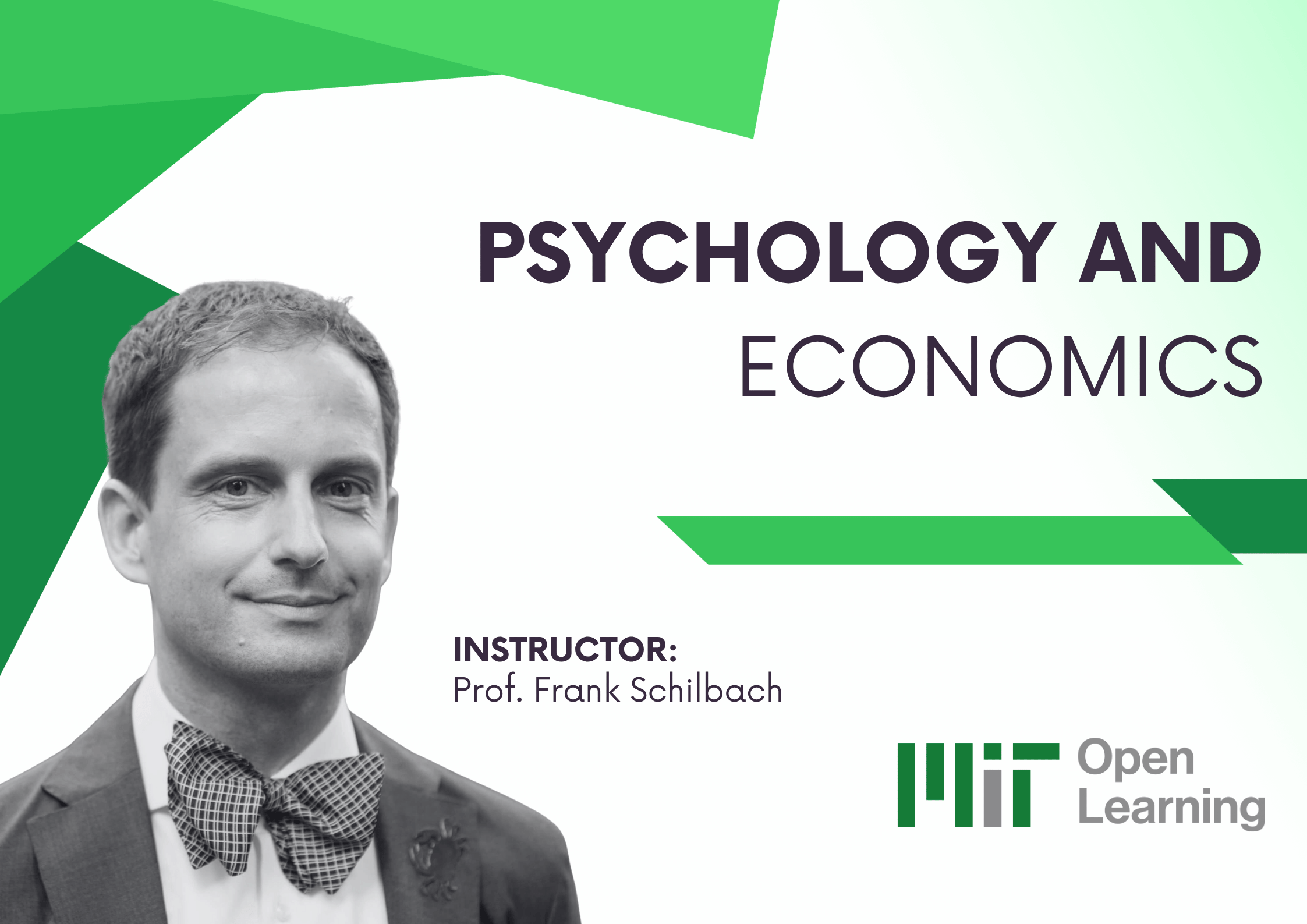

This course examines psychological biases and bounded rationality to develop more realistic policies and analyses in the field of economics.
Introduction to Psychology and Economics
-
Course Description
Course Videos
-
Lecture 1: Introduction and Overview
-
Lecture 2: Time Preferences (Theory)
-
Lecture 3: Time Preferences (Applications)
-
Lecture 4: Risk Preferences
-
Lecture 5: Reference-Dependent Preferences
-
Lecture 6: Social Preferences
-
Lecture 7: Mid-Term Review
-
Lecture 8: Limited Attention
-
Lecture 9: Utility from Beliefs; Learning
-
Lecture 10: State-Dependent Preferences, Projection, and Attribution Bias
-
Lecture 11: Gender, Discrimination, and Identity
-
Lecture 12: Defaults, Nudges, and Frames
-
Lecture 13: Malleability and Inaccessibility of Preferences
-
Lecture 14: Poverty Through the Lens of Psychology
-
Lecture 15: Happiness and Mental Health
-
Lecture 16: Policy with Behavioral Agents
About This Course
This course integrates insights from psychology and the social sciences with economics, moving beyond the traditional assumption of fully rational individuals. It examines systematic deviations in human behavior such as cognitive biases, bounded rationality, and social preferences and applies these findings to labor economics, public economics, health economics, finance, industrial organization, and development economics. The goal is to equip students with both the theoretical foundations and the practical ability to design policies and research incorporating behavioral insights.
Prerequisites
Because this course studies deviations from mainstream economic models, a solid understanding of those models is essential. Therefore, 14.01 Principles of Microeconomics, or an equivalent introductory microeconomics course, is a prerequisite.
Instructor
Frank Schilbach is an Associate Professor of Economics at the Massachusetts Institute of Technology (MIT), specializing in behavioral and development economics. His research explores the cognitive and behavioral dimensions of poverty, examining how “mental stress, sleep deprivation, substance use, and barriers to information diffusion” shape the economic decisions of individuals living in poverty.
Schilbach received his PhD in Economics from Harvard University in 2015. He previously completed a Diploma in Economics at the University of Mannheim and a master’s degree in economics at the University of California, Berkeley.
At MIT, he co-directs the Behavioral Development Lab in India alongside Gautam Rao and Heather Schofield. He is also a Faculty Research Fellow at the National Bureau of Economic Research (NBER) and a research affiliate at J-PAL, CEPR, and BREAD.
-
 Lean StartupKişisel GelişimIt teaches how to build efficient business models by applying lean entrepreneurship principles, including team building,...
 726
 312
-
 Video Analiz ve Karar Destek SistemiKişisel GelişimBu sınav, Yapay Zeka Dil Ajanları Yarışması katılımcılarına özel olarak hazırlanmıştır.
726
312
-
 7. Substance PainterKişisel Gelişim
726
312
Bekleyebilirsiniz?
-
 Kendi hızınızda öğrenin
Belirli bir program olmadan ve takip etmesi kolay bir yöntemle evden öğrenmenin tadını çıkarın.
-
 Ön sıra koltukları alın
Sınırsız erişimle, tekniğinizi mükemmelleştirmek için ihtiyaç duyduğunuz kadar izleyebilirsiniz.
-
 Profesyonel olarak hazırlanmış kursları izleyin
Eduvence, yüksek kaliteli, çevrimiçi bir öğrenme deneyimi sağlamak için eğitmen kadrosunu özenle oluşturur.
-
 En iyi profesyonellerden öğrenin
Yaratıcı sektördeki en iyi uzmanlar tarafından açıklanan değerli yöntemleri ve teknikleri öğrenin.
-
 Sertifikalar
Her kurs için onaylı özel bir sertifika alın. Portföyünüzde, sosyal medyada veya istediğiniz her yerde paylaşın.
-
 Bilgi ve fikirlerinizi paylaşın
Sorular sorun, geri bildirim isteyin veya çözümler sunun. Öğrenme deneyiminizi diğer öğrencilerle paylaşın.